Elysium guides

- Native HYPE pays Elysium gas; the listed canonical WHYPE is an ERC-20 bridge representation.
- Elysium USDC and USDC on Solana are balances on different networks.
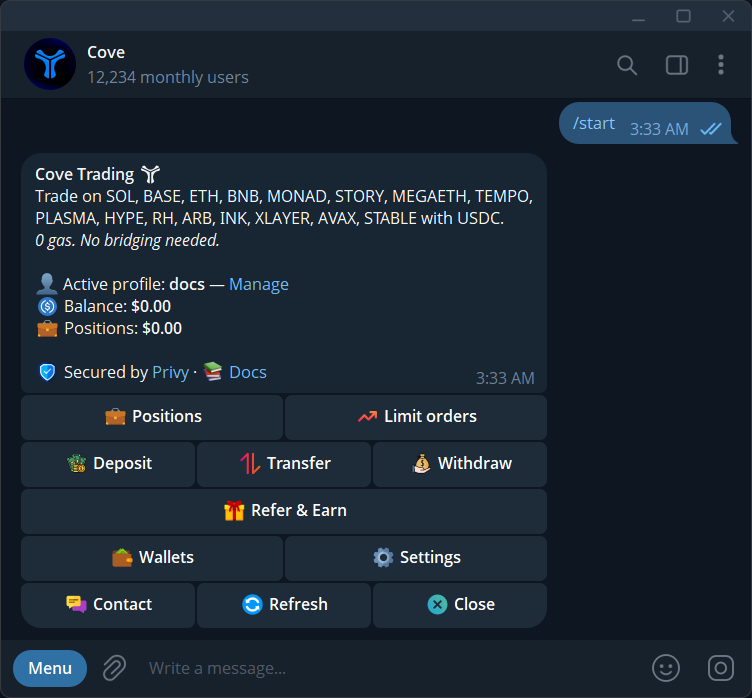
- Use cove's live Deposit panel for funding; token existence does not establish deposit support.
Three assets, three different jobs
Elysium uses native HYPE to pay network transaction fees. USDC is a dollar-denominated asset commonly used for pricing and funding. WHYPE is a tokenized form of HYPE; the official Elysium bridge reference lists the representation of HyperEVM WHYPE. They may appear together in an app, but they are not interchangeable balances.
For cove, there is another distinction: the spendable trading balance is USDC on Solana. An Elysium token panel can be traded from that balance through a supported route. An external wallet holding USDC on Elysium is a different situation and does not automatically increase the spendable balance in cove.
Verified Elysium USDC and WHYPE addresses
The official Elysium bridge documentation, checked November 9, 2026, lists the following mainnet representations. Use chain ID 99901 when looking them up. These are references for identifying tokens, not addresses to which you should send a deposit.
- USDC on Elysium: 0xb47c4C8F73F009CC0C0d3f92B388d13E293F0B65.
- Original USDC on HyperEVM: 0xb88339CB7199b77E23DB6E890353E22632Ba630f.
- WHYPE on Elysium: 0xbA876237B0F021A6c6D852d6c26E107997cC5E81.
- Original WHYPE on HyperEVM: 0x5555555555555555555555555555555555555555.
Why a WHYPE balance may not pay gas
Native HYPE is the balance the chain uses for ordinary gas payments. The WHYPE address above is the bridged representation of an ERC-20 on HyperEVM. Its name does not mean that the network automatically treats it as native gas. Do not assume that an unwrap button for a different wrapped token will handle this representation.
If a wallet reports insufficient gas while displaying WHYPE, inspect the native HYPE balance on Elysium itself. HYPE held on HyperEVM is on another network. Follow the official bridge documentation or the app's supported conversion path to obtain the asset needed for the operation. Do not send tokens to a contract address in an attempt to convert them.
USDC on Elysium is not the same as cove Balance
A token ticker tells you very little about where funds are spendable. The same wallet address can hold USDC on several EVM networks, while cove's displayed trading balance follows its own documented funding workflow. A transfer that succeeds on one chain does not move the asset to another chain.
To fund a cove Elysium trade, the straightforward documented path is to use the personal Solana deposit address shown in cove and send USDC on Solana. For other routes, open Deposit and match the network, supported asset and destination address exactly. Some received assets require conversion or bridging before they become spendable trading funds.
Read pools and quotes in the correct units
An Elysium market may quote a token against USDC or WHYPE. A token's price expressed in WHYPE changes meaning when HYPE's dollar price changes. Check the quote asset before comparing two charts or interpreting a percentage move. A pool's quoted value also differs from the amount obtainable for a specific order.
In cove, review the actual input and expected output shown for your trade, together with fees and price impact. After execution, use the receipt for the amounts spent and received. Neither a stablecoin label nor a wrapped-token relationship removes bridge, contract, liquidity or execution risk; each describes only one part of the asset.
Sources & further reading
- Elysium bridge: USDC and WHYPE contracts
- Elysium native gas model
- cove deposit guide
- cove trading balance and setup
Product settings and availability can change. Check the current documentation before using a feature. Educational content does not predict trading outcomes.
How we approach our content